Light is one of the most familiar things in our lives. We see it every day, yet the deeper we look into its nature, the stranger it becomes. It travels at the ultimate speed limit of the universe, behaves as both a wave and a particle, and has a remarkable relationship with space and time. Perhaps most astonishingly, the passage of time along a photon’s journey is zero, while a human traveling close to the same speed could experience a few years as centuries pass elsewhere.
What exactly is light?
When we think of light, we usually imagine sunlight, a light bulb, or perhaps a laser beam. But visible light is only a tiny fraction of something much larger: the electromagnetic spectrum.
Radio waves, microwaves, infrared radiation, visible light, ultraviolet radiation, X-rays, and gamma rays are all forms of the same phenomenon. What distinguishes them is their frequency, wavelength, and the energy carried by their photons.
Light is an electromagnetic phenomenon, consisting of oscillating electric and magnetic fields. In classical physics, these fields propagate through space as waves. In quantum physics, electromagnetic radiation also comes in discrete packets of energy called photons.
This is where things become interesting. Light exhibits both wave-like and particle-like properties. It can interfere with itself, producing patterns characteristic of waves, yet it can also be detected as individual photons.
The famous double-slit experiment demonstrates this beautifully. Even when photons are sent through an apparatus one at a time, the accumulated detection pattern can show interference. Quantum mechanics predicts the probabilities of where individual photons will be detected, but it does not describe them as ordinary little balls following simple, predetermined paths.
In other words, light is not quite like anything we encounter in everyday life.
How fast does light actually travel?
299,792,458 m/s
The exact speed of light in a vacuum
That’s approximately 299,792 kilometers per second, or 1.079 billion kilometers per hour.
At this speed, light could travel around Earth’s equator roughly 7.5 times in a single second.
And this isn’t merely a very accurate measurement. Since 1983, the meter itself has been defined using the speed of light, making its numerical value exact in SI units.
Yet despite its extraordinary speed, light is not instantaneous.
Consider how long it takes light to reach some familiar destinations:
| Journey | Approximate travel time |
|---|---|
| One meter | 3.34 nanoseconds |
| Earth to Moon | 1.28 seconds |
| Sun to Earth | 8 minutes 19 seconds |
| Sun to Neptune | 4 hours 10 minutes |
| Sun to Proxima Centauri | 4.24 years |
| Across the Milky Way | 100,000 years |
These figures reveal something extraordinary about astronomy: looking into space is also looking into the past.
When we observe the Sun, we see it as it was more than eight minutes ago. When we observe a galaxy a billion light-years away, we are receiving light emitted roughly a billion years ago, although cosmic expansion makes the relationship between distance and lookback time more complicated at such enormous scales.
Our telescopes are, in a very real sense, time machines. They cannot show us the future, but they allow us to observe the distant past.
Why is the speed of light always the same?
One of the strangest discoveries in physics is that the speed of light in a vacuum is the same for every observer moving at a constant velocity, regardless of their own motion.
Imagine standing beside a railway track while a train passes at 100 km/h. Someone on the train throws a ball forward at 20 km/h relative to the train. From your perspective, the ball moves at approximately 120 km/h.
That makes perfect sense.
Now imagine the passenger switches on a flashlight and points it forward.
You might expect the light to travel at the speed of light plus the speed of the train. But it doesn’t.
Both the passenger and the person standing beside the tracks measure the light traveling at exactly the same speed: c.
How is that possible?
Because space and time are not independent, absolute quantities.
Albert Einstein’s special theory of relativity, published in 1905, showed that measurements of time intervals and distances depend on the relative motion of the observer.
The universe does not preserve our everyday assumptions about absolute time and distance. Instead, it preserves the speed of light.
This has consequences that are almost impossible to imagine intuitively.
Why can’t we accelerate to the speed of light?
Imagine building an incredibly powerful spacecraft. Its engines are capable of continuously accelerating it, and we somehow solve all the practical problems of fuel, propulsion, and survival.
Could we eventually reach the speed of light?
According to our current understanding of physics, the answer is no.
Anything with a nonzero rest mass, including atoms, spacecraft, planets, and human beings, cannot be accelerated to c.
The reason lies in how energy and momentum behave at relativistic speeds.
At ordinary velocities, adding energy to an object increases its speed in a familiar way. But as the object’s velocity approaches the speed of light, each additional increase in speed requires progressively more energy.
As the velocity v approaches c, the denominator approaches zero, and the required energy grows without limit.
Reaching exactly the speed of light would require infinite energy.
It doesn’t matter whether the spacecraft weighs one kilogram or a million tonnes. If it has rest mass, the same restriction applies.
This doesn’t mean that objects become infinitely massive in the modern definition of mass. Their invariant mass remains unchanged. What increases without limit is their energy and momentum.
Even the most powerful particle accelerators on Earth cannot push protons or electrons to exactly the speed of light. They can bring them extraordinarily close, but never all the way.
And there is another important detail: accelerating for a longer time doesn’t somehow bypass this limit. The spacecraft may continue accelerating as measured by instruments on board, while its speed relative to its original starting point approaches c without ever reaching it.
So why can photons travel at the speed of light?
This is where photons differ fundamentally from ordinary matter.
Photons have zero rest mass.
They are not tiny objects that start from rest and accelerate until they reach the speed of light. A photon in a vacuum always propagates at c.
It cannot be brought to rest, and there is no valid reference frame in which a photon is stationary.
A photon also carries energy and momentum despite having no rest mass.
Higher-frequency photons carry more energy. A gamma-ray photon therefore has far more energy than a photon of visible light, while a radio photon carries much less.
But in a vacuum, all of them travel at the same speed.
This is an important distinction. Photons do not travel at c because they have somehow overcome the limitations imposed on matter. They belong to a different category of particles: massless particles, whose energy-momentum relationship requires them to propagate at c in a vacuum.
It is simply part of their nature.
Does light slow down in water or glass?
Yes, but there is a subtle distinction.
Light travels more slowly through materials such as water, glass, and air than it does through a vacuum.
For example, the effective propagation speed of visible light through ordinary glass is often around two-thirds of c, depending on the type of glass and the wavelength.
This happens because electromagnetic radiation interacts with the charged particles within the material. These interactions change how the wave propagates through the medium.
It does not mean that an individual photon has acquired rest mass or that the fundamental speed limit of the universe has changed.
The speed c remains the same.
In fact, charged particles can travel through a material faster than light propagates through that material, without exceeding c in a vacuum. This produces Cherenkov radiation, the characteristic blue glow sometimes visible in water surrounding nuclear reactor cores.
Do photons experience time?
Perhaps the most fascinating question of all is what happens to time at the speed of light.
According to relativity, moving clocks run slower relative to an observer when the clocks are moving with respect to that observer.
As an object approaches c, this effect becomes increasingly dramatic.
Now consider a photon traveling from a distant star to Earth.
From our perspective, that journey might take millions or even billions of years.
But along the photon’s lightlike path through spacetime, the proper time between emission and absorption is zero.
This is the mathematical basis of the popular statement that photons do not experience the passage of time.
However, there is an important qualification.
We cannot literally describe what a photon sees or experiences. A photon has no rest frame, and special relativity does not allow us to adopt the perspective of something moving at exactly c.
It would therefore be misleading to say that a photon consciously experiences the entire journey instantaneously.
The scientifically accurate statement is that the proper time along a photon’s path is zero, even though observers with ordinary clocks can measure a substantial travel time.
Stanford University’s Gravity Probe B relativity explanations make this same distinction: asking how time passes in a photon’s own reference frame is not physically meaningful.
Nevertheless, the underlying mathematical result is remarkable.
A photon emitted billions of years ago can reach a telescope today, with zero proper time separating those two events along its trajectory.
And this brings us to an even stranger possibility: what happens when a human being travels almost as fast?
Time dilation: traveling into the future
Imagine two identical twins, both 30 years old.
One remains on Earth. The other boards a spacecraft capable of traveling at an enormous fraction of the speed of light.
The spacecraft departs, travels through space, eventually turns around, and returns to Earth.
When the traveling twin steps out of the spacecraft, something astonishing has happened.
The twins are no longer the same age.
The astronaut has aged less than the twin who remained on Earth.
This is not science fiction. It is a direct consequence of special relativity, commonly illustrated by the famous twin paradox.
Time dilation means that the amount of time measured between events depends on the path an observer takes through spacetime.
And the closer a spacecraft travels to the speed of light, the greater the difference becomes.
How much would time slow down?
Let’s imagine a spacecraft traveling at different percentages of c, measured relative to Earth.
The following table shows how much time would pass on Earth while exactly one year passes aboard the spacecraft, assuming constant relative velocity and ignoring acceleration and gravitational effects.
| Spacecraft speed | Time on Earth |
|---|---|
| 50% of c | 1.15 years |
| 80% of c | 1.67 years |
| 90% of c | 2.29 years |
| 95% of c | 3.20 years |
| 99% of c | 7.09 years |
| 99.9% of c | 22.37 years |
| 99.99% of c | 70.71 years |
| 99.999% of c | 223.61 years |
Notice how dramatically the numbers change near the bottom of the table.
At 90% of the speed of light, the effect is already substantial. But at 99.999%, one year aboard the spacecraft corresponds to more than 223 years in Earth’s reference frame.
And we still haven’t reached the speed of light.
Mathematically, as the spacecraft’s velocity gets closer and closer to c, the time dilation factor increases without limit.
That means a traveler could theoretically experience only a few years while thousands, millions, or even billions of years pass elsewhere, provided the necessary journey and energy were physically achievable.
There is no known upper limit to the time dilation factor for a massive object traveling below c.
But would time actually feel slower?
Here’s an important detail that is often misunderstood.
The astronaut would not feel time slowing down.
Their heartbeat would remain normal. Their thoughts would proceed at their usual pace. Their watch would tick once per second, and they would age normally according to their own clock.
From inside the spacecraft, nothing unusual would happen to the local passage of time.
The difference becomes apparent when comparing clocks that have followed different paths through spacetime.
For a spacecraft moving at a constant velocity, an observer on Earth sees the spacecraft’s clock running slowly. But the astronaut can also regard Earth as moving and calculate that Earth’s clocks are running slowly.
This apparent contradiction is resolved by the relativity of simultaneity. Different observers disagree about which distant events happen at the same time.
In the twin paradox, the situation becomes asymmetric because one twin turns around and returns, changing inertial reference frames. When the twins reunite, they can directly compare their ages.
The traveling twin has genuinely experienced less elapsed time.
Neither twin’s clock was defective. They simply followed different paths through spacetime.
Could we travel thousands of light-years in a single lifetime?
Surprisingly, yes, at least in principle.
Consider a destination 1,000 light-years from Earth.
Even traveling at 99% of the speed of light, the journey would take a little over 1,010 years according to clocks on Earth.
For the travelers, however, the elapsed time would be approximately 142 years. Still far too long for an ordinary human lifetime.
But increase the velocity to 99.9999% of c, and the situation changes dramatically.
At that speed, a journey of 1,000 light-years would take approximately 1,000 years from Earth’s perspective, but only about 1.4 years aboard the spacecraft.
The spacecraft has not exceeded the speed of light.
Instead, the travelers experience less time and measure the distance to their destination as being much shorter because of another relativistic effect: length contraction.
This is one of the most extraordinary implications of relativity.
The universe doesn’t allow us to travel faster than light, but it does allow the experienced duration of an enormous journey to become remarkably short.
Of course, accelerating a spacecraft to such velocities would require extraordinary amounts of energy. Collisions with interstellar dust and radiation would also become serious hazards, and slowing down at the destination would present another enormous challenge.
So while the physics permits these hypothetical journeys, the engineering remains far beyond anything we can currently accomplish.
Space and time are connected
Einstein’s work fundamentally changed our understanding of reality.
Before relativity, space and time were generally treated as separate, absolute entities. Space was the stage on which events happened, while time flowed uniformly for everyone.
Relativity replaced that picture with spacetime: a four-dimensional structure in which distances and time intervals depend on the observer’s motion.
In this framework, time dilation and length contraction are not unrelated curiosities. They are different consequences of the same underlying geometry.
One useful way to understand this is through the idea of a light clock.
Imagine a clock consisting of two mirrors, with a pulse of light bouncing between them. Every round trip represents one tick.
For someone traveling with the clock, the light simply moves up and down.
But an observer watching the clock move sideways sees the light follow a longer diagonal path.
Since both observers must measure the same speed of light, the observer watching the moving clock concludes that each tick takes longer.
This is a simplified but powerful illustration of why time dilation occurs.
The speed of light remains constant, so our measurements of space and time must adjust.
Is time dilation actually proven?
Yes. Time dilation is not merely an interesting mathematical prediction.
It has been measured experimentally in several independent ways.
One particularly convincing example involves muons, unstable elementary particles produced when cosmic rays collide with Earth’s atmosphere.
Muons have an average lifetime of approximately 2.2 microseconds when measured in their own rest frame.
Without relativistic time dilation, many of the fast-moving muons created high in the atmosphere would decay before reaching the Earth’s surface.
Yet large numbers of them do reach the ground.
Their high velocities mean that, from Earth’s perspective, their internal decay processes are slowed by relativistic time dilation.
Particle accelerators have also confirmed this effect with extraordinary precision.
Another famous experiment involved transporting atomic clocks aboard aircraft and comparing them with clocks remaining on Earth. The measured differences agreed with the predictions of relativity, including both velocity-related and gravitational effects.
And perhaps the most practical example is GPS.
Satellites carry extremely accurate clocks, but those clocks do not run at exactly the same rate as clocks on Earth.
Their orbital motion causes special-relativistic time dilation, while the weaker gravitational field at their altitude causes a larger effect in the opposite direction.
The combined correction is approximately 38 microseconds per day.
That may sound insignificant, but GPS positioning relies on extremely precise timing. Ignoring relativistic corrections would produce rapidly growing navigation errors.
Relativity is not just a theory about distant galaxies and imaginary spacecraft. It is part of the physics behind technology we use every day.
Can gravity slow down time too?
Yes, and this is where Einstein’s general theory of relativity enters the picture.
Time is affected not only by relative motion but also by gravity.
A clock closer to a massive object generally runs more slowly than a clock farther away, when the clocks are compared under suitable conditions.
Even here on Earth, a clock at sea level runs slightly slower than a clock at the top of a mountain.
The difference is extremely small, but modern atomic clocks are precise enough to measure it.
Near extremely massive and compact objects, the effects become much more dramatic.
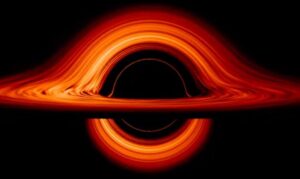
A black hole provides one of the most extreme examples.
Imagine a spacecraft hovering close to a black hole, outside its event horizon. To a distant observer, the spacecraft’s clock would run increasingly slowly as it approached the horizon.
In principle, a relatively short period for someone near a black hole could correspond to a much longer period for someone far away.
But there are serious practical complications. Hovering near the event horizon requires enormous acceleration, and depending on the black hole’s mass, tidal forces and radiation could be deadly.
An observer falling freely toward a black hole, meanwhile, would not see their own time stop. They would cross the event horizon after a finite amount of time measured by their own clock.
The popular idea that time simply freezes at a black hole’s horizon is therefore an oversimplification of what a distant observer sees.
Can anything travel faster than light?
According to established relativity, no object or signal can locally carry information faster than c through a vacuum.
But there are some fascinating situations that appear to challenge this limit.
For example, the universe itself is expanding.
At sufficiently large distances, galaxies can recede from us at an effective rate greater than the speed of light because the space between us is expanding.
This does not mean those galaxies are locally traveling through space faster than light. Cosmological recession and ordinary motion through space are different concepts.
Quantum entanglement presents another apparent mystery.
Two entangled particles can exhibit correlations across enormous distances, even when their measurements are separated in ways that prevent a light-speed signal from connecting the events.
However, these correlations cannot be used to transmit controllable information faster than light.
And then there are speculative ideas such as wormholes and warp drives.
Some mathematical solutions to Einstein’s equations suggest ways in which spacetime geometry might permit effective faster-than-light travel without an object locally exceeding c.
But these concepts face enormous theoretical problems, including exotic energy requirements and questions about stability and causality.
There is currently no experimental evidence that a practical faster-than-light propulsion system is possible.
Why does the universe have a speed limit at all?
This may be the deepest question of the entire subject.
We know the speed of light in a vacuum. We know how it fits into Maxwell’s equations of electromagnetism and Einstein’s theories of relativity.
We can calculate its consequences with remarkable accuracy.
But why does the universe have this particular limiting speed?
Why approximately 300,000 kilometers per second rather than a million, or a thousand?
Part of the answer is that the numerical value depends on our chosen units. In theoretical physics, scientists often use units in which c is simply equal to 1.
The deeper question is why spacetime has the causal structure it does, with a finite invariant speed separating events that can influence one another from those that cannot.
In relativity, this limiting speed is not fundamentally a property belonging only to light. It is a property of spacetime itself.
Light travels at that speed because photons are massless.
Gravitational waves also propagate at c in a vacuum, according to general relativity, and observations are consistent with this prediction.
So perhaps the familiar expression “the speed of light” is somewhat misleading.
It is really the speed of causality: the maximum speed at which information and physical influences can propagate locally.
Light just happens to be the most familiar phenomenon that travels at this limit.
What do we still not understand about light?
Despite centuries of research, light remains connected to some of the biggest unanswered questions in physics.
We understand its electromagnetic behavior extraordinarily well, and quantum electrodynamics is among the most accurately tested theories ever developed.
Yet some fundamental mysteries remain.
We still do not have a universally accepted interpretation of what quantum mechanics tells us about physical reality. The mathematics predicts experimental outcomes extremely successfully, but physicists disagree about how to understand the underlying quantum state and the process of measurement.
We also lack a complete, experimentally verified theory unifying quantum physics with gravity.
Questions about the microscopic structure of spacetime, the earliest moments of the universe, and what happens at the center of black holes remain unresolved.
Even the idea of a photon traveling through space becomes more subtle when examined through quantum field theory, where photons are excitations of the electromagnetic field rather than tiny classical objects with definite trajectories.
And although experiments place extremely stringent limits on any possible photon rest mass, the theoretical framework of standard electromagnetism treats the photon as exactly massless.
The more deeply we investigate light, the more it reveals about the universe — and the more questions we discover.
A final thought: light, time, and our place in the universe
There is something profoundly strange about the relationship between light and time.
A photon emitted by a distant galaxy can travel across the universe for billions of years before reaching Earth.
For us, that journey spans an almost unimaginable period.
Entire civilizations could rise and disappear. Stars could form, burn, and die. Galaxies could collide and merge.
Yet the proper time along the photon’s path remains zero.
Meanwhile, a hypothetical astronaut traveling sufficiently close to the speed of light could cross enormous cosmic distances within their own lifetime, only to discover that thousands of years had passed back home.
Neither situation violates the laws of physics.
They are consequences of the same universe we inhabit every day.
We tend to think of time as something universal, flowing steadily and equally for everything and everyone. But modern physics tells us that this intuition is wrong.
There is no single cosmic clock that governs the entire universe.
The passage of time depends on motion, gravity, and the path taken through spacetime.
Perhaps the most remarkable thing about light is not its extraordinary speed, but what that speed has taught us about reality.
Space and time are not the rigid background of the universe. They are part of its structure, and light helps reveal how that structure works.
We have learned to measure light, manipulate it, transmit information through it, and observe the history of the cosmos with it.
But understanding why the universe has the fundamental properties it does remains one of science’s greatest challenges.
And that is what makes light so fascinating. Something we encounter every moment of our lives is also a doorway into some of the deepest mysteries of existence.
Further reading and scientific references
For readers interested in the science behind these ideas:
-
NIST — Definitions of SI Base Units — the exact definition of the speed of light.
-
Stanford University — Special and General Relativity Questions — including the question of time and photons.
-
NIST — The Metre and the Speed of Light — how light became the basis for measuring distance.
-
BIPM — International Definition of the Metre — the international measurement standard.