I joined Tinder recently mostly out of curiosity. I wasn’t on a desperate mission to find a partner, nor was I trying to game the system, spam anyone, promote anything, or create fake accounts. I created a normal profile using my real age and my own photographs and started looking through profiles.
Apparently, that was suspicious enough for Tinder.
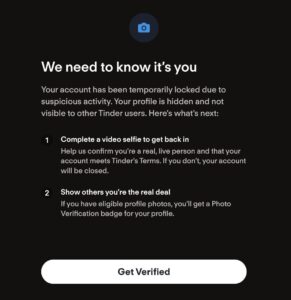 From ordinary swiping to a locked account
After swiping left on several profiles — possibly rather quickly — I was suddenly stopped by a message telling me that Tinder needed to verify that I was really me.
Fine. Anti-bot and anti-fraud systems are understandable on a dating platform. Fake profiles are a real problem, and asking a suspicious account to prove that a human being is behind it isn’t inherently unreasonable.
There was just one immediate problem: I was using Tinder on a PC without a camera.
Unlike many modern identity-verification systems, the interface I encountered didn’t offer an obvious way to transfer the verification process to a phone. Eventually I figured out myself that I could log into the same account on my phone and continue there.
So I did.
I have a good front-facing camera and a reasonably well-lit room. The video-selfie process itself worked perfectly. My face was clearly visible, the capture completed without difficulty, and the photographs on my Tinder profile really are photographs of me.
I submitted the verification.
 Tinder then told me that my account was under review and that, if I passed, my account would be reinstated.
So far, so good.
Except that instead of resolving the problem, Tinder eventually sent me straight back to the beginning:
“We need to know it’s you.”
Again.
Fine. I’ll prove that I’m me. Again.
Perhaps something had gone wrong the first time. Software fails. Networks fail. Automated image analysis fails.
So I gave Tinder the benefit of the doubt and performed the video verification a second time.
Same real person. Same real face. Good camera. Good lighting. No difficulty completing the procedure.
And then I found myself facing the same verification state again.
At that point, this stops being a reasonable security measure and starts looking like a broken loop.
Tinder asks me to prove that I am me. I comply. Tinder processes the verification. Instead of either approving me or clearly rejecting me and explaining what failed, it apparently forgets that the exercise happened and asks me to prove that I am me again.
How many video selfies am I supposed to send?
Three?
Ten?
A hundred?
At what point is a user entitled to conclude that nobody is actually capable of resolving the state the account has entered?
Tinder’s own documentation describes a process that is supposed to terminate
This is what makes the experience particularly frustrating.
Tinder’s official documentation says that its automated safety systems or human moderators can trigger what it calls Photo Check when they detect unusual activity. The user is then required to submit a video selfie.
That’s fair enough.
But Tinder also says that once Photo Check has been successfully completed, the account is unlocked and the user can continue using the app normally.
That is a process with an endpoint:
Suspicious activity → Photo Check → successful verification → account unlocked.
What I encountered instead appears to be:
Suspicious activity → Photo Check → review → Photo Check → review → Photo Check → review → Photo Check → review → Photo Check → review → Photo Check → review → Photo Check → review → Photo Check…
That’s not verification. That’s a loop.
And searching for other people’s experiences makes the situation even less reassuring. There are Reddit discussions from users describing apparently similar verification loops, including people who say they repeatedly completed verification without regaining normal access. Anecdotes on Reddit obviously don’t establish how common a software problem is, but they do show that the experience isn’t necessarily unique.
The biometric aspect makes a broken loop worse
There is another reason this deserves better engineering than an ordinary broken login screen.
This isn’t Tinder repeatedly asking me to solve a CAPTCHA.
It’s asking for my face.
According to Tinder’s own documentation, Photo Check uses facial geometry derived from the video selfie. Tinder says the original video selfie is promptly deleted, but it retains verification data and two audit images according to its stated retention policies.
That doesn’t automatically make the system sinister. Facial verification can serve legitimate anti-fraud and user-safety purposes.
But if a company asks users to provide biometric information, the corresponding process should be exceptionally reliable and transparent.
A system shouldn’t repeatedly say, in effect:
“Give us another scan of your face and perhaps this time our system will figure itself out.”
If verification succeeds, unlock the account.
If verification fails, say that it failed and explain what the user can reasonably do about it.
If a human review is required, say so.
If the account has actually been banned for another reason, say that.
But repeatedly throwing the user back into the same biometric-verification process without a meaningful explanation is terrible system design.
What was my suspicious activity?
I don’t actually know what triggered Tinder’s system, and I won’t pretend that I do.
My best guess is that I swiped left on several profiles quickly.
I have some immediate deal-breakers. For example, if I see tattoos, I swipe left. I don’t need thirty seconds to contemplate that decision. Likewise, certain other characteristics can make the decision immediate.
That can naturally produce several fast left-swipes in succession.
Perhaps Tinder’s automated systems interpreted such behavior as bot-like. Perhaps something entirely different triggered the check. Tinder hasn’t told me.
And that distinction matters.
I don’t object to Tinder detecting unusual behavioral patterns and asking for additional verification. False positives are inevitable in any automated fraud-detection system.
What matters is what happens after the false positive.
A good security system has a recovery path for legitimate users.
A bad one traps them inside the security system.
I hadn’t even done anything interesting yet
The absurdity is that this happened almost immediately after I joined.
I hadn’t harassed anyone. I hadn’t sent spam. I hadn’t tried to scam anybody. I hadn’t impersonated another person. My age was real. My photographs were real.
I was basically just browsing profiles and swiping.
And somehow, within an extremely short period, Tinder managed to transform the experience from a dating app into an automated identity-verification dispute.
That’s quite an accomplishment.
Security doesn’t excuse unusable software
I can already imagine the defense: Tinder has millions of users, bots and scammers are everywhere, and aggressive automated security is necessary.
I agree with the premise.
I reject the conclusion that therefore any behavior by the security system is acceptable.
Security and usability aren’t opposites. A well-designed service needs both.
An anti-fraud system that occasionally challenges legitimate users is understandable. An anti-fraud system that challenges them and then apparently cannot process their successful attempts to comply is defective.
The distinction is important.
I’m not criticizing Tinder for verifying users.
I’m criticizing Tinder because, in my experience, the verification process itself appears incapable of reaching a stable conclusion.
My Tinder experience so far
So what has Tinder provided me?
I created an honest profile.
I browsed some profiles.
I swiped left and right.
Tinder decided that something about this was suspicious.
It demanded a video selfie.
I supplied one.
It put my account under review.
Then it demanded verification again.
I supplied another video selfie.
And I ended up facing the verification system again.
At this point, I’m tired of sending Tinder selfies.
If the company doesn’t trust the first verification, it should tell me why.
If it doesn’t trust the second verification, it should tell me why.
If its system is malfunctioning, it should detect that condition and provide an escalation path instead of restarting the same process.
And if Tinder simply doesn’t want me using its service, that’s fine too. Tell me that and let us both move on.
What I don’t accept as reasonable software behavior is an indefinite loop asking a legitimate user to perform the same biometric verification over and over while providing no useful explanation of what is actually wrong.
Conclusion
I joined Tinder out of curiosity.
I wasn’t expecting miracles from online dating. I wasn’t even particularly concerned about whether I got matches.
But I did expect the application to remain functional long enough for me to actually use it.
Instead, my most substantial interaction with Tinder has been repeatedly proving to Tinder that my own face belongs to me.
Perhaps my account will eventually escape the loop. Perhaps support could somehow fix it. Perhaps the fourth, fifth or tenth video selfie would magically be the one that satisfies whatever state machine has gone wrong behind the scenes.
I’m no longer interested in finding out how many repetitions it takes.
If a service demands biometric verification from its users, the absolute minimum it owes them in return is a verification system that actually works.
Mine didn’t.
And that’s my Tinder experience so far.
Update: I Finally Got Back In
Some time after publishing this article, I refreshed Tinder website one more time — and, unexpectedly, the verification screen was gone. My account was accessible again.
It took three video-verification attempts followed by a long wait to get there. During that time, Tinder gave me no useful indication of what was happening. Instead of telling me that my verification had been received and was still being reviewed, it kept returning me to the same “We need to know it’s you” screen, making it look as though I needed to perform the process again.
I also now appear to have the filled verification badge next to my name, so apparently at least one of those attempts was eventually accepted.
I’m glad the account was finally restored, but this doesn’t really change my criticism of the process. If the correct action after submitting verification was simply to wait, Tinder should have said so. A user shouldn’t have to guess whether a verification is pending, has failed, or needs to be repeated.
So the loop wasn’t permanent after all. It just looked permanent because Tinder provided essentially no meaningful status information while I was stuck in it.
And, for the record, my account mysteriously started working only after I published this article. I’m sure that’s entirely coincidental.
Probably.